

New Retirement Index reveals World's Top Retirement Destinations

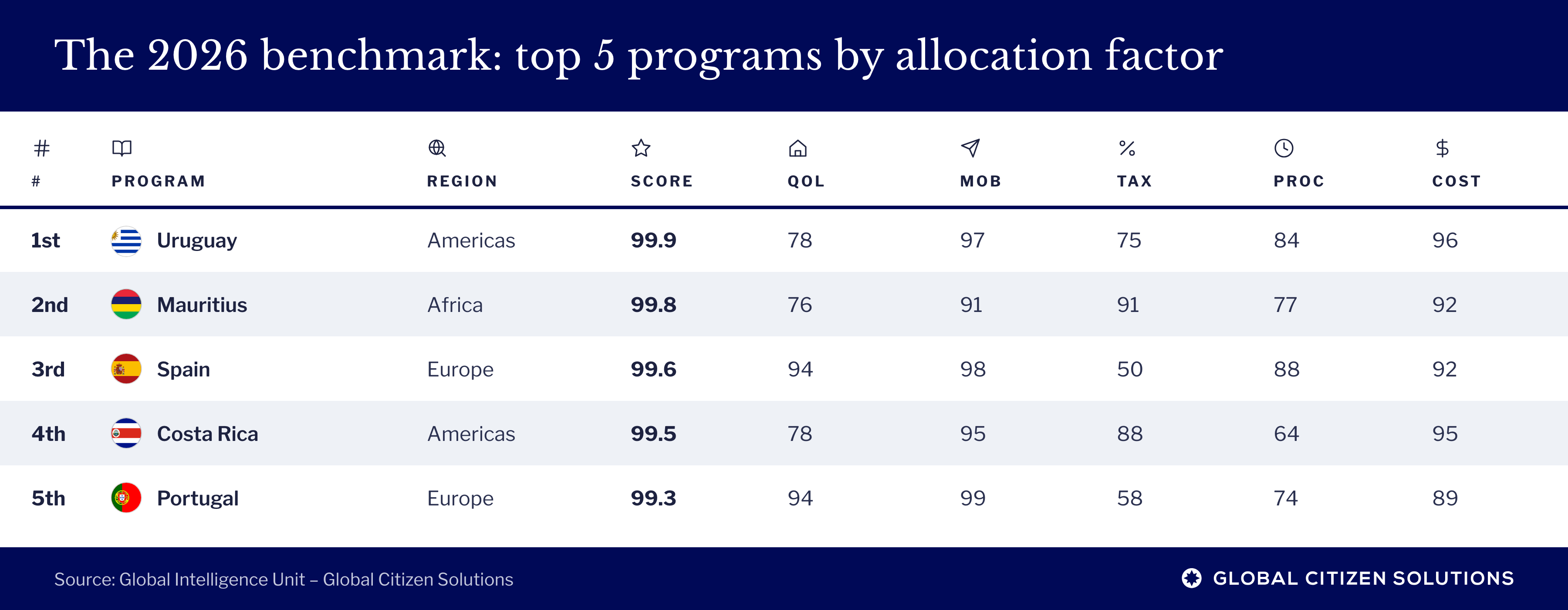
The Top Five Retirement Visas
Global Citizen Solutions published its 2026 Global Retirement Index, a comparative benchmark of 46 retirement or passive-income visa programs worldwide.
The Index´s central finding is that a retirement visa is best understood as an asset; a way to diversify tax, lifestyle and political exposure”
LONDON, UNITED KINGDOM, September 30, 2026 /EINPresswire.com/ -- Uruguay tops the Index of 46 retirement and passive income visas worldwide, followed by Mauritius and Spain— Patricia Casaburi, CEO, Global Citizen Solutions
Portugal slides from 1st to 5th place after doubling its timeline to Citizenship
Global Citizen Solutions (“GCS”), a leading global residency and citizenship planning advisory firm, today launches its 2026 Global Retirement Report & Index, a comparative benchmark of 46 retirement or passive-income visa programs worldwide. Developed by GCS's research arm, the Global Intelligence Unit (“GIU”), the Index scores each program across five pillars: quality of life, mobility and citizenship, tax, procedure and costs.
Uruguay, Mauritius and Spain top the 2026 ranking, with Costa Rica and Portugal completing the leading five of “all-rounders.” The 2026 edition covers 46 jurisdictions across Europe, the Americas, Asia-Pacific, the Middle East and Africa, each represented by its flagship retirement or passive-income route, such as Portugal's D7 Visa or Spain's Non-Lucrative Visa. Quality of life carries the most weight, followed by mobility and citizenship, then the financial and procedural pillars, reflecting what matters most to a typical internationally mobile retiree.
Figure: The 2026 Benchmark, the top ten retirement and passive-income programs, ranked by overall score, with each program's strongest and weakest factor. Source: GCS Global Intelligence Unit.
Patricia Casaburi, CEO of Global Citizen Solutions explains “The Index´s central finding is that a retirement visa is best understood as an asset; a way to diversify tax, lifestyle and political exposure. With the global population aged 65 and over set to nearly double to 1.6 billion by 2050, we’re looking at a generation of retirees who will live longer, be more numerous, and more mobile than ever before. The countries that design their programs around that reality will shape the next decade of retirement mobility.”
Key Findings from the 2026 Global Retirement Report & Index:
1. Residency as an asset class. The report reframes a retirement or passive-income visa as an allocation decision rather than paperwork, one that delivers quality of lifestyle, tax optimization, mobility and, above all, optionality.
“A retirement visa belongs in the same conversation as any other asset allocation decision: what lifestyle dividend does it pay, what fiscal exposure does it hedge, and does it give you a credible, pre-established alternative base if you ever need one,” said Dr. Laura Madrid, lead Researcher at GCS’s Global Intelligence Unit.”
2. The defining trade-off is tax versus lifestyle. Fiscal advantage and quality of life/mobility are inversely correlated; the low-tax winners are rarely the quality of life winners. Only four jurisdictions escape the trade-off: Uruguay, Mauritius, Costa Rica and Paraguay, and together they take four of the top six places. The UAE and Bahrain score maximum on tax and speed yet land 19th and 42nd, dragged down by lower mobility in Bahrain’s case and no route to citizenship in either Gulf countries.
3. The citizenship window is narrowing with program pathways becoming more restrictive. Portugal has doubled its naturalization pathway from five years to ten (seven for EU and Portuguese-speaking-country nationals), the clearest signal yet of a broader European restriction of access to citizenship, which cost Portugal its crown in this year’s edition of the Global Retirement Index. With Italy and Ireland restricting citizenship by descent, closing the door for potential applicants across the world, passive income visas become an important option for retirees.
4. The right program depends on the mandate, not the headline rank. Re-weighting the Index around a specific objective reshuffles the table: the UAE, 19th overall, tops a tax-driven mandate, while Spain, third overall, leads on quality of life, mobility and family.
5. Citizenship optionality is geographically concentrated. A strong passport paired with a defined naturalization pathway clusters in the European Union and much of Latin America. Of the 46 programs, 24 offer naturalization within five years and 17 within six to ten years, while four (Malta, the UAE, Ireland and Bahrain) offer no standard path at all. The fastest pathways are in South America, led by Argentina at roughly two years.
6. Qualifying income thresholds vary. Spanning roughly US$600 to US$10,600 a month. Costa Rica is the standout value (a top-five program for about US$1,000), while Andorra, Malta and Bahrain sit at the premium end.
7. The dual-nationality trap. 11 countries (Austria, Andorra, UAE, Malaysia among them) either restrict or don't permit dual nationality, so naturalizing there means renouncing your original passport — for anyone unwilling to do that, the route caps out at permanent residence.
Europe leads on lifestyle and mobility; its programs take the entire top five of the mobility and citizenship pillar (Greece, Italy, France, Portugal and Cyprus), but it lags on tax and shows the widest internal spread of any region.
The Americas win on cost, fiscal efficiency and depth, with strong-passport, fast-naturalization programs in Brazil, Argentina and Chile punching above their weight and helping drive Uruguay and the South America’s strong overall showing.
Africa rests on the Mauritius outlier, while the Middle East remains a pure tax-and-speed specialist, delivering zero-tax regimes and rapid execution but no pathway to a second passport.
GCS points to structural forces moving retirement mobility from niche to mainstream: the global population aged 65 and over is projected to roughly double, from 761 million in 2021 to approximately 1.6 billion by 2050, alongside more than 60 million dollar-millionaires worldwide and rising, a generational wealth transfer already underway, and younger cohorts increasingly planning for early or flexible retirement.
The full 2026 Global Retirement Report & Index is available from GCS's Global Intelligence Unit at: https://www.globalcitizensolutions.com/report/2026-global-retirement-report-and-index/
About Global Citizen Solutions
Global Citizen Solutions is a leading global residency and citizenship planning advisory firm, helping high-net-worth clients and their families secure greater control over where they can live, travel, do business, and operate across jurisdictions, globally.
E J M D S LEGGE-BOURKE
Global Citizen Solutions
email us here
Visit us on social media:
LinkedIn
Instagram
Facebook
YouTube
Legal Disclaimer:
EIN Presswire provides this news content "as is" without warranty of any kind. We do not accept any responsibility or liability for the accuracy, content, images, videos, licenses, completeness, legality, or reliability of the information contained in this article. If you have any complaints or copyright issues related to this article, kindly contact the author above.
